

ISSN (Print): 2349-5987
ISSN (Online): 2348-8336
Generative Artificial Intelligence (AI) Policy
Purpose
The purpose of this policy is to provide clear guidance on the responsible and ethical use of generative artificial intelligence (AI) in the preparation, evaluation, and publication of manuscripts submitted to the International Journal of Physiotherapy (IJPHY). The policy ensures that all scholarly work maintains transparency, accountability, originality, and integrity, while enabling safe and responsible adoption of AI technologies.
- General Principles
- Human Responsibility: All content submitted, reviewed, or published in IJPHY is the responsibility of human authors, editors, and reviewers. AI tools cannot assume authorship or ethical accountability.
- Transparency: Any use of AI in preparing or editing manuscripts must be fully disclosed. Transparency ensures that editors, reviewers, and readers understand the role AI played in the work.
- Confidentiality: Manuscripts, peer-review reports, and editorial correspondence must remain confidential. AI platforms must not be used in ways that compromise privacy or intellectual property.
- Editorial Judgment: All decisions regarding acceptance, rejection, or revision of manuscripts must be made by human editors based on scientific, clinical, and methodological expertise.
- Integrity of Research: AI may not be used in ways that distort or misrepresent research findings. Its use should enhance clarity and accuracy without substituting for human expertise or critical thinking.
Rationale: These principles ensure that AI is a supportive tool rather than a replacement for human judgment, maintaining trust in the research record and the publication process.
- Policy for Editors
2.1 Editorial Responsibility and Independence
- Editors are fully accountable for the content and integrity of published work.
- AI must not be used to make decisions about manuscript quality, ethical compliance, or scientific relevance.
- Decisions must be based on human expertise, clinical judgment, and knowledge of research methodology.
2.2 Confidentiality and Manuscript Handling
- Manuscripts, supplementary files, and peer-review materials must never be uploaded to third-party AI platforms.
- AI may only be used for administrative or integrity-supporting functions (e.g., plagiarism detection) on secure, journal-approved platforms.
- Manuscript data, peer-review comments, and internal editorial discussions are confidential and must not be exposed to external AI systems.
2.3 Oversight of AI Use by Authors
- Editors must ensure that any declared AI use by authors is transparent and clearly described in the manuscript.
- AI-assisted language editing is permitted but must not replace scientific reasoning, analysis, or conclusions.
- Any suspected undisclosed or inappropriate AI use should be addressed internally through editorial review.
2.4 Editorial Training
- Editors must stay informed about advances in AI technologies relevant to scholarly publishing.
- The editorial board will periodically review and update this policy to reflect best practices, emerging technologies, and journal-specific requirements.
- Policy for Reviewers
3.1 Responsibilities
- Reviewers must provide independent, expert evaluations based on clinical knowledge, methodological understanding, and scientific judgment.
- Reviews must remain confidential, objective, and free from personal or institutional bias.
3.2 Prohibited AI Use
- Reviewers must not upload any part of the manuscript—including text, tables, figures, or supplementary material—to AI platforms.
- AI cannot be used to draft, paraphrase, or improve the language of review reports.
3.3 Preparation of Peer-Review Reports
- Reviewers are fully responsible for the content, accuracy, and tone of their reports.
- Scientific and clinical judgments must be made independently; AI-generated suggestions cannot influence evaluations.
3.4 Author AI Use
- Reviewers should acknowledge any declared AI use by authors for language or formatting assistance.
- Focus should remain on assessing scientific validity, originality, methodological rigor, and clinical relevance.
- Any suspected undisclosed or inappropriate AI use should be confidentially reported to the handling editor.
3.5 Compliance
- Breaches of this policy may lead to removal from the reviewer pool and internal journal-led actions.
- Reviewers are encouraged to consult the editorial office if they are uncertain about the appropriateness of AI use during the review process.
- Policy for Authors
4.1 Accountability
- Authors are fully responsible for the accuracy, originality, and integrity of all content, including AI-assisted text.
- Failure to accurately report AI use may lead to rejection or retraction.
4.2 Acceptable AI Use
- AI may be used only for:
- Grammar, spelling, and language clarity improvements
- Formatting assistance (e.g., reference formatting, stylistic adjustments)
- Data organization or modeling where human oversight is maintained
- All AI-assisted work must be reviewed, verified, and approved by the authors.
4.3 AI Disclosure
- Any AI assistance must be disclosed in a dedicated statement placed before the References section.
- Example disclosure: “Portions of this manuscript were edited using AI-based language tools. The authors reviewed and approved all content.”
4.4 Authorship
- AI cannot be listed as an author or contributor.
- Authorship requires intellectual contribution, accountability for content, and the ability to respond to inquiries.
4.5 Visual Content
- AI-generated images, figures, or graphical data are prohibited unless explicitly approved by the editorial office.
- Only minor adjustments for brightness, contrast, or readability are allowed. Data must not be altered in a way that misrepresents research findings.
4.6 AI in Research Methodology
- AI tools that are part of study design, data analysis, or modeling may be used with full disclosure.
- Authors must describe:
- Software and model versions
- Data sources and preprocessing steps
- Training, validation, and parameter settings
4.7 Verification and Editorial Oversight
- The editorial office may request:
- Raw data
- Original images
- Technical documentation
- Compliance ensures that AI use aligns with the principles of transparency and research integrity.
4.8 Policy Enforcement
- Noncompliance may result in:
- Rejection of the manuscript
- Retraction of published articles
- Formal notification to institutional authorities, if necessary
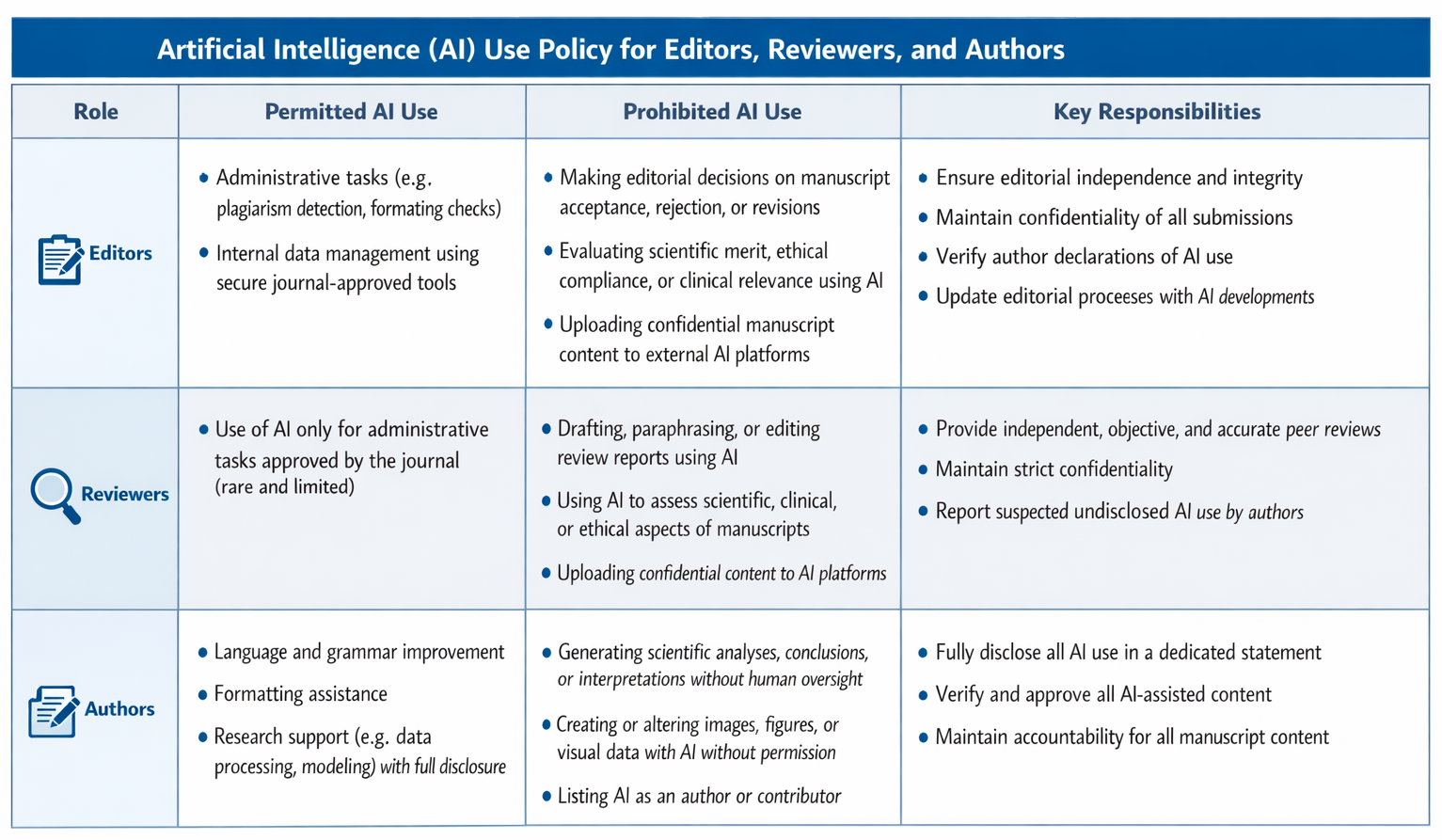
- Summary Table of Responsibilities for AI Use
Contact: Authors seeking clarification on AI use should contact editor@ijphy.com


 This work is licensed under a